
Tom Green Projected vs Actual Release
The official TDCJ label is Projected Release Date. It is the date on which TDCJ Classification and Records currently projects that a sentenced person will leave incarceration if parole does not occur first. It is based on the judgment, offense date, sentence, jail credit, sentence structure, statutory rules, and information in the state record. It can change. An actual release date records completed departure from TDCJ custody.
Other dates mark different stages. Parole eligibility means a case may be reviewed. A Board vote states a decision, which may have a month, program, or transfer condition. Mandatory-supervision calculations follow their own law. Discharge or maximum expiration ends sentence control, subject to unrelated cases. None of those labels should be substituted for another.
A pretrial detainee in Tom Green County Detention Center does not have a TDCJ projected date. Court action, bond, dismissal, plea, sentencing, and holds can determine the next event. Even a sentenced county-jail term must be verified through the judgment, jail credit, court, and Sheriff records rather than a state-prison formula.
Find a Tom Green Release Date
Classify the custody before searching. The same Tom Green County case can move from the county detention center to TDCJ, another county, federal custody, or immigration custody. The agency that currently owns the sentence record is the source for its projected date.
- For a TDCJ prisoner, open the TDCJ offender search. Use a TDCJ number or SID when possible, or search the exact name and confirm age and conviction details.
- Read the result fields separately. Note the current unit, Projected Release Date, parole-review information, custody status, actual release date, and reporting office when supplied.
- If the public form is inconclusive, email pia@tdcj.texas.gov with the full name and seven-digit TDCJ number. Without the number, include exact birth date or age and conviction county.
- For a county-jail sentence or pending case, inspect the signed judgment, sentence length, jail credit, and docket through the proper Tom Green clerk. Ask the jail for its existing computation or release record.
- For an old event, request the existing actual release, release mode, maximum date, and public incarceration history from TDCJ or the Sheriff as appropriate.
The Tom Green County release search shows how to reconcile the county timestamp with the court disposition. A release card can prove when TGCDC processed departure, but it does not state the reason or destination.
Texas Good Time for Tom Green Cases
Texas Government Code Chapter 498 governs TDCJ good-conduct time. Section 498.003 says good time affects eligibility for parole or mandatory supervision but does not otherwise reduce the sentence. It is a privilege, not a right. Classification and disciplinary history therefore matter to the projection.
The statutory classification schedule can credit 20 days per 30 days actually served for trusty or Class I status, with possible additional trusty credit; Class II can receive 10 days per 30, while Class III and certain statuses receive none. Those rates are inputs, not promises. A classification change or forfeiture can alter the record.
Mandatory supervision generally compares calendar time plus accrued good time with the sentence, subject to offense-date rules, statutory exclusions, and Board review. Section 508.149 lists exclusions. For an eligible offense before September 1, 1996, TDCJ describes release at the projected point if parole has not occurred. For an eligible offense on or after that date, the Board has a discretionary role. If release is denied or the person is ineligible, the displayed projection may become the discharge or maximum date.
Note: Never apply a TDCJ good-time rate to a Tom Green county-jail sentence; the judgment, jail credit, holds, and Sheriff computation control that path.
Why Tom Green Release Dates Change
A projected date reflects the current legal and administrative record. Later events can move the estimate, change the release mode, or block community release. The safest reading records each factor without doing private sentence math.
| Factor | Possible effect | Best source |
|---|---|---|
| Good-time classification | Credits accrue at a different rate | TDCJ Classification and Records |
| Disciplinary forfeiture | Good time may be lost or status may change | TDCJ time record |
| Parole Board action | Release may occur earlier, be denied, or require a program | TDCJ and Board status |
| Mandatory-supervision decision | Board findings may allow or deny the calculated release | Board decision and Chapter 508 |
| Detainer or hold | Departure may become transfer to another authority | TDCJ and receiving-agency record |
| New court order | Sentence, credit, concurrency, or custody may change | Signed court order |
| Consecutive sentence | Another sentence may delay final release | Judgment and TDCJ computation |
A favorable FI-1 or FI-2 vote is an authorization path, not gate release. Program-related vote codes require action before release. Review and Release Processing handles progress after approval. Administrative checks, a release plan, detainers, and new legal events can still intervene.
Confirm Tom Green Actual Release
For a pending county event, Texas IVSS-Counties can provide a prospective custody alert when the agency and person are covered. A received alert should be preserved and checked against TGSO’s official 48 Hour Release list. The Sheriff card supplies an exact release timestamp but omits reason and destination. Request the release screen, transfer notation, or court instrument when that distinction matters.
For TDCJ, use the actual release date, current custody or supervision status, and location. A reporting parole office or “on supervision” supports release from prison while the sentence continues. A prison unit and “in custody” mean incarceration has not ended. The Tom Green IVSS check explains why county and TDCJ registrations remain separate.
If the displayed TDCJ date seems wrong, contact Classification and Records at 936-437-6231 or classify@tdcj.texas.gov. Supply the TDCJ number, date of birth, cause and judgment, and exact disputed field. The agency corrects its record. A legal dispute over the judgment belongs with the court or counsel.
Texas Has No 85 Percent Rule
Texas has no universal rule requiring every prisoner to serve 85 percent of a sentence. Government Code Section 508.145 contains several parole-eligibility formulas. Many ordinary cases reach consideration when actual time plus good time equals one-fourth of the sentence or 15 years, whichever is less. Serious-offense provisions can require one-half of the sentence in actual calendar time or 30 years, whichever is less, with further limits and exclusions.
Eligibility is not an entitlement to release. The Board can deny parole, and mandatory supervision has separate eligibility and review rules. The offense, offense date, judgment, sentence structure, good-time status, and statutory category must all be known. A national shorthand cannot replace those facts.
This distinction is especially important for Tom Green cases that begin in the county jail. A future TDCJ field applies only after state intake and computation. County jail credit may be reflected in the judgment and later TDCJ calculation, but the public cannot safely derive an exact gate date from a charge and sentence length alone.
Tom Green Date Computation Steps
The state sequence starts with the judgment, offense date, sentence length, and jail credit. It then considers concurrent or consecutive sentences. TDCJ applies the statutes effective for the offense, decides mandatory-supervision eligibility, tracks calendar time and good-conduct classification, and records disciplinary forfeitures. Parole eligibility and mandatory supervision remain separate calculations.
Four labels should stay visible in any summary: projected release, parole eligibility or review, Board decision, and actual release or discharge. A person can be eligible while still in prison. A favorable decision can remain conditional. An actual release can lead to parole supervision. A later discharge ends the sentence but does not erase unrelated cases or continuing duties.
For older records, the public search may be incomplete after full discharge. A narrow TDCJ public-information request should seek the actual release or discharge date, release mode, maximum date, conviction history, and public supervision status. The no-charge email route supplies listed status fields but does not provide photographs.
Sentence structure requires special care. Concurrent terms run together under the judgment, while consecutive terms can extend the controlling period. Jail credit belongs in the official computation. A court may later correct or clarify the judgment, and TDCJ must apply the controlling order. Readers should record the field and its source date instead of presenting a hand calculation as an agency promise.
Mandatory supervision and parole are also easy to merge by mistake. Mandatory supervision uses a calendar-time and good-time framework for eligible cases, with Board review for modern offenses. Parole is a discretionary release decision after eligibility. Either route can produce supervision after prison. Neither proves final discharge, and a detainer can turn the physical departure into transfer.
Tom Green TDCJ Date Source
The official TDCJ projected-date information page explains the alternate email route when the public offender search is inconclusive.
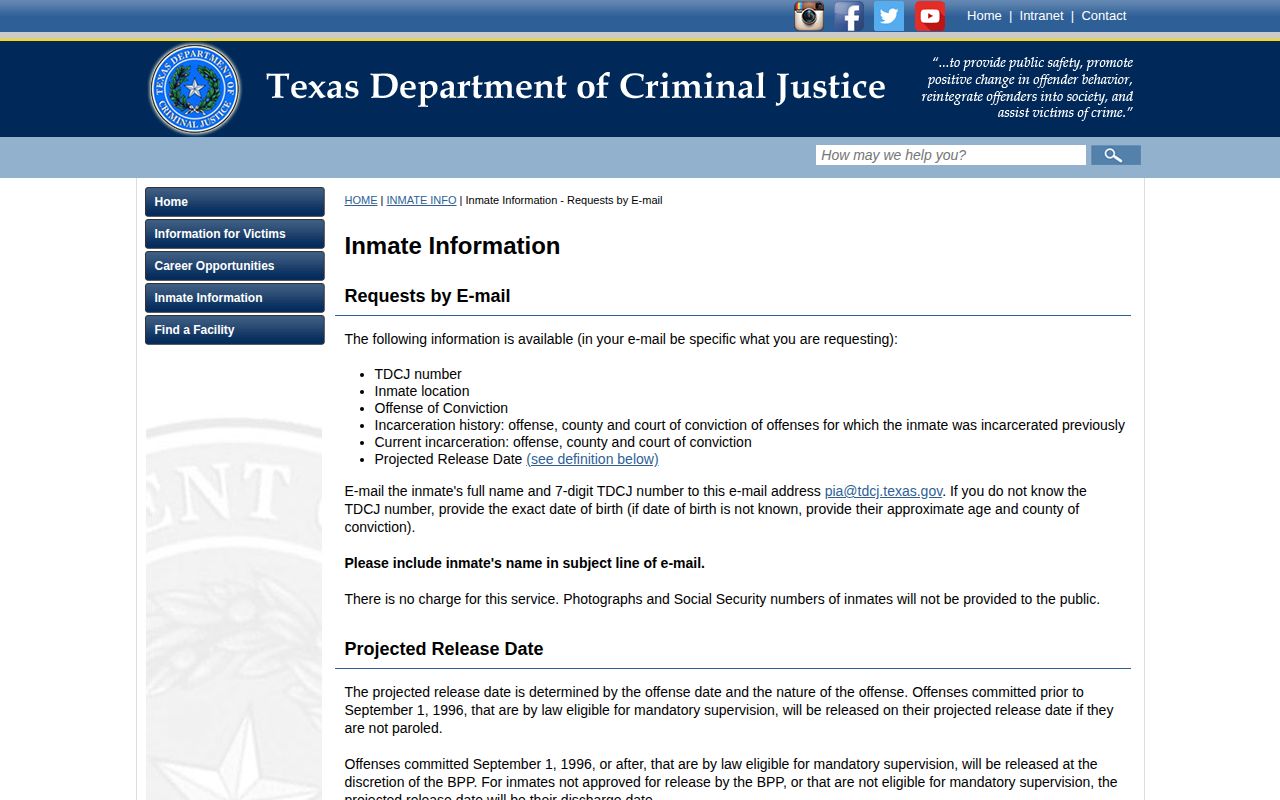
The page is an explanatory source, not an individual release result. Match any returned field to the correct TDCJ number and verify actual release separately.
TDCJ Classification and Records can address inmate time, transfers, and release-field questions. Its public contact is 936-437-6231 and classify@tdcj.texas.gov. A precise inquiry names the person, TDCJ number, birth date, cause, judgment, and disputed field. Broad questions such as “When will this person get out?” omit the facts needed to reconcile a projected date. When the issue is a court judgment rather than agency data entry, the filed order and proper legal process control.
Record the date on which the projected field was checked. A later lawful change does not make the earlier screen false, but it does make that screen stale. The current agency record governs.